
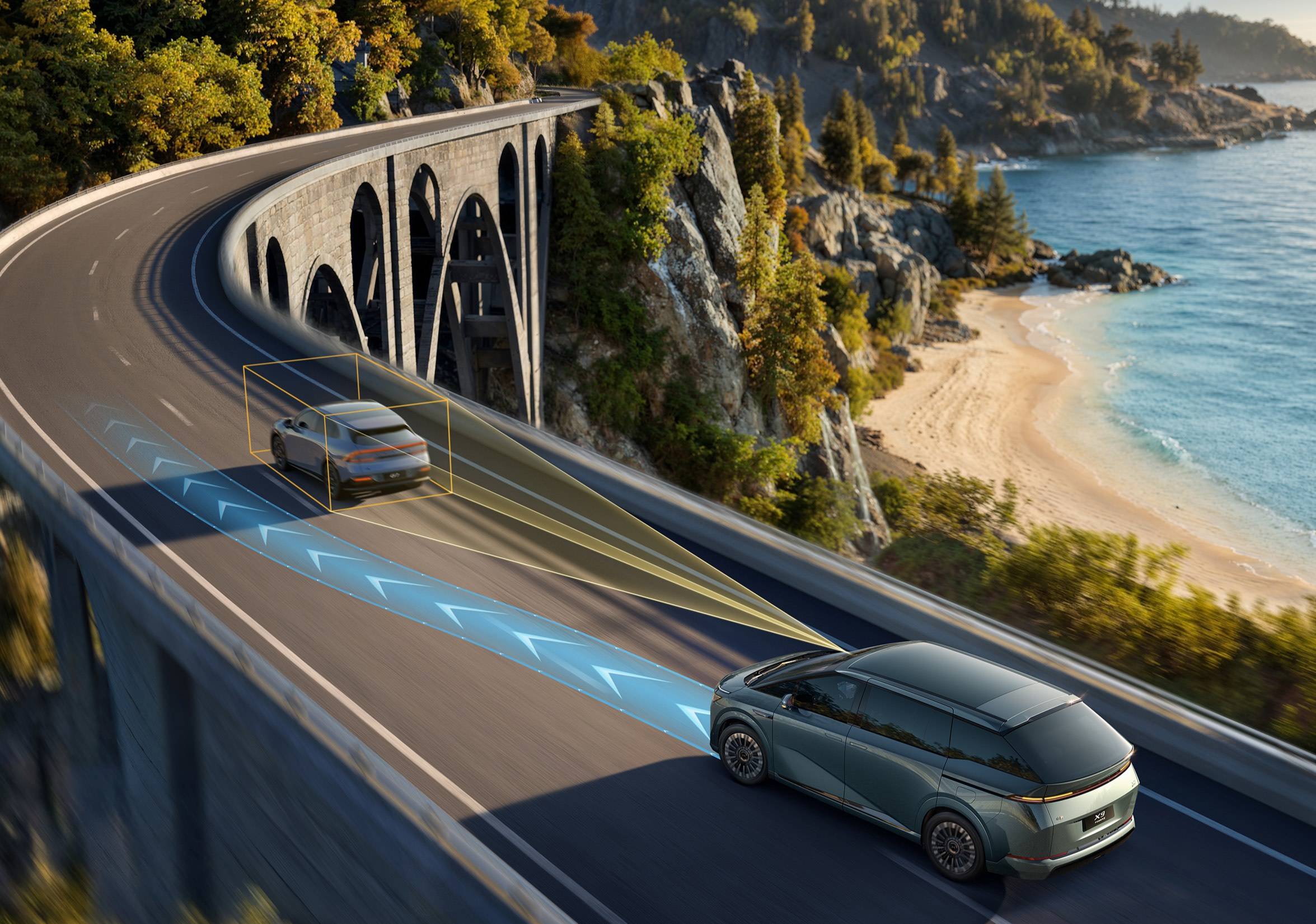
XPeng says it has built an autonomous driving system that behaves so much like a human driver, passengers may not be able to tell the difference. In a recent demonstration, the company showcased what it described as a "Turing test for driving"—an experiment designed to see whether people could distinguish between decisions made by a human and those made by its AI.
The timing matters. Volkswagen has already partnered with XPeng to integrate this technology into future vehicles in China, signaling a broader shift: traditional automakers are increasingly relying on AI-driven software developed outside their own walls.
Xpeng's VLA, Vision-Language-Action, approach collapses the traditional autonomous driving stack. Previously, AV systems divided the problem into modules: perception sees the road, prediction models what other vehicles will do, planning decides what to do next. That approach has proven brittle once they encounter edge case. Like Tesla's FSD and Nvidia's Drive Hyperion , Xpeng's VLA 2.0 replaces that pipeline with a single end-to-end model that works directly from visual inputs to controlling the driving. No handoffs, no translation layers, no hardcoded rules.
The Numbers Behind the Claim
Xpeng built VLA 2.0 on its own proprietary Turing AI chip, which delivers 2,250 TOPS (tera operations per second) of effective compute per chip. Each robotaxi vehicle carries four chips, giving roughly 3,000 TOPS of total on-board compute - currently among the highest deployed in any production vehicle. This mirrors Tesla's approach with FSD and similarly, the system runs on cameras alone. No need for lidar or high-definition maps. Like Tesla Xpeng's working towards a system cheap enough to deploy at consumer scale and adaptable enough to work on roads they've never seen.
Deutsche Bank analysts who evaluated VLA 2.0 in March described it as "a comprehensive leap forward, reaching new heights in smoothness, all-scenario capability, and efficiency."
On March 11, Xpeng launched consumer test drives for VLA 2.0 across 732 stores throughout China, running on the P7 Ultra, G7 Ultra, and X9 Ultra. OTA updates for the broader lineup follow in April.
The Volkswagen Signal
Western media tend to ignore Chinese automakers but on February 24, when He Xiaopeng announced that Volkswagen had become VLA 2.0's first commercial launch customer, that caught their attention. No Western mass-market automaker has ever licensed core autonomous driving software from a Chinese company at this scale. Volkswagen will deploy VLA 2.0 on its China-market EVs.
For two decades, the assumed direction of automotive technology transfer has been west-to-east. Western OEMs brought platform expertise, safety engineering, and manufacturing discipline into joint ventures with Chinese partners. The Chinese side contributed market access. That arrangement is reversing across multiple categories simultaneously - EVs, batteries, software-defined vehicles - and now autonomous driving.
Robotaxi on the Near Horizon
On March 23, Xpeng formally established a standalone Robotaxi Business Unit. The division is responsible for product definition, R&D testing, and day-to-day operations. Three mass-produced robotaxi models are planned for 2026, with passenger-carrying demonstration operations in China scheduled for the second half of this year. Fully driverless L4 commercial operations are targeted for 2027.
Xpeng CEO, He Xiaopeng, has said he believes full autonomy will arrive "within the next one to three years." Given the pace of VLA 2.0's development and the commercial validation from Volkswagen, that timeline looks more credible today than it would have a year ago.
What We're Watching
China has become a crucible for new technology with multiple domestic companies driving forward in AI, robotics, EV, batteries and solar with a fierce competitive energy.
The US-based companies aren't standing still either. Waymo has been running a commercial L4 service in multiple US cities, but it depends on lidar arrays, high-definition pre-mapped zones, and a network of roughly 70 remote fleet response agents - based in Arizona, Michigan, and the Philippines - who advise vehicles in unusual situations. The system works, but it doesn't scale cheaply and it doesn't generalize beyond mapped territory. Tesla is moving fast in a different direction: unsupervised FSD pilots launched in Austin in mid-2025, the Cybercab rolled off the production line in February 2026, and full production is expected to start in April this year.
Xpeng is building a strong lead over its Chinese peers in the autonomous driving space and has the potential to become a serious competitor to the tech giants. Volkswagen's licensing of the technology signals a turning point where traditional automakers are no longer leading innovation - they're buying it.
See It for Yourself
Brian White (@FutureAza) did one of the most thorough on-the-ground demos of VLA 2.0 available - real-world conditions, no PR filter. Worth watching - Chinese roads are for the feint of heart.
Learn More
- XPENG Shares Achievements in Physical AI Emergence: Unveils VLA 2.0, Robotaxi, and Flying Car - Xpeng Press Room, January 2026
- XPENG Accelerates Global Deployment of VLA 2.0 With Public Road Testing and 2027 Delivery Plan - Xpeng Press Room, March 2026
- Xpeng to kick off VLA 2.0 test drives on Mar 11 as analysts see autonomous driving leap - CnEVPost, March 10, 2026
- Volkswagen Becomes XPENG's First Customer for VLA 2.0 Intelligent Driving System - CleanTechnica, March 3, 2026
- XPeng sets up Robotaxi unit, eyes pilot operations in second half of this year - TechNode, March 24, 2026
- Volkswagen Partners with XPeng, First Global Automaker to License Chinese L4 Software - The China Academy, March 2026
- XPeng VLA 2.0 With Volkswagen Puts Autonomy Upside In Focus - Yahoo Finance, March 2026
- Tesla Cybercab Production Will Begin In April 2026, Elon Musk Says - InsideEVs, 2026
- Waymo admits remote human workers overseas intervene in unusual situations - KTLA, 2026